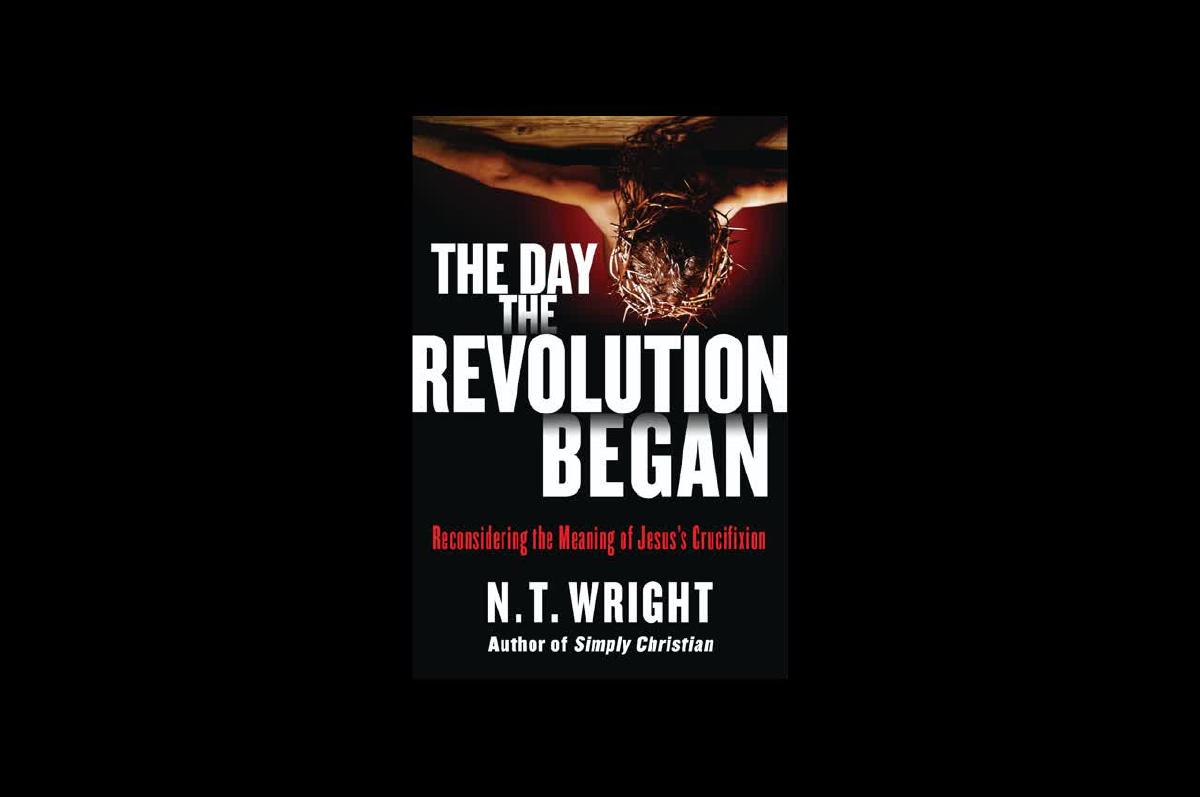

This is a book review, click here to find out why I write them, and here to find the list books I've reviewed already.
Introduction#
So many studies on the Atonement, as previously mentioned, focus on the New Testament epistles in general and Paul’s letters in particular. It is somewhat understandable as, virtually each page of this section of the New Testament references the death of Jesus in one way or the other.
In N.T. Wright’s study, he does not intend to do a detailed exploration of a theology of the cross as found in the epistles as that would take a whole book by itself. He seeks rather to address central passages where Paul says, according to him, the very same things that the evangelists have said about Jesus’s death, although from “different angles and in a variety of different contexts”. After all, Paul is among those “who received” that which he himself now delivers “as of first importance” unto the Corinthians; “that Christ died for our sins in accordance with the Scriptures” (1 Corinthians 15:3).
“Why only Paul?”, you’d ask. N.T. Wright wishes he had looked closely in particular at the Letter to the Hebrews, the First Letter of Peter and the book of Revelation, but was constrained with space since Paul’s material is sufficient for a lifetime of study. In any case, Wright says that the remaining letters “offer other angles of vision” complementing the picture he sketches in this book (350).
So, how does Paul talk about the cross and is what he says in line with what Wright has been saying so far? Is it all in line with Wright’s “covenant of vocation”? Does Paul make Passover the interpretative grid the same way our Lord does so himself (according to what we learned from the gospels)? Wright selects a few key texts and goes through their respective contexts to make his case.
Galatians#
Wright starts with Paul’s letter to the Galatians, which according to him, is about “unity” rather than what many have assumed to be a letter about “salvation”. Obviously, the theme of salvation comes through the letter but it’s not, according to Wright, the central argument. What God promised to Abraham is finally coming to pass: a “single family in which believing Jews and believing Gentiles form one body” (234), and that has come to pass thanks to the cross. How does Wright figure that out?
In the opening statement in 1:3-4, Paul talks about how Jesus gives “himself for our sins, to rescue us from the present evil age”. Wright identifies a Passover echo here as there’s a redemption and liberation from a hostile power which is clearly in view. This is a new Exodus, “not from political enslavement under pagan empires, as in the original Exodus, but from the ultimate enslavement under the force of Sin as a power” (235). In this perspective, the themes of return from exile and forgiveness of sins fit in very well if we grant that Jesus’s death accomplishes what the ultimate Exodus is supposed to achieve. The Passover narrative, according to Wright, is not only prevalent, but, “at the center of the letter” (237). Take what Paul says in 4:3-7 when he talks about those who were “kept in slavery” but who are now “redeemed…so that we might receive adoption as sons”. Redemption is spoken about again in 3:13-14:
Christ redeemed us from the curse of the law by becoming a curse for us – for it is written, “Cursed is everyone who is hanged on a tree” – so that in Christ Jesus the blessing of Abraham might come to the Gentiles, so that we might receive the promised Spirit through faith.
Wright doesn’t waste the opportunity to show, through these two verses, how our presentations of the Gospel have fallen short. We usually speak of Jesus bearing a “curse” for us, so that we might be “justified” and “go to heaven”. Paul instead talks of a different goal altogether: the fulfillment of Abraham’s promises. Wright reaffirms penal substitution as Christ bearing “the Deutoronomic curse” (penal) so that no one has to bear the curse anymore (substitution). He criticizes the “Platonizing distortions” of always reading passages with a “going to heaven” goal when it is really about, according to Wright, returning to the Abrahamic promise and vocation of being the means of the blessing for the whole world. The Gentiles are therefore included and that’s why Wright says that Paul’s central argument in the letter is the unity of the family, that is, that the Messiah now has one family, not two (242), as was supposed by those who wanted to force Gentiles to become Jews and impose some sort of ethnic separation. To suppose there’s still separation is to deny the Gospel itself and to put into question the death of Christ.
According to Wright, this letter speaks of the death of Christ as the event that declares the “present evil age” (which held people captive) null and void, and now launches the “age to come” which belongs to the delivered people of God (243). Therefore, recognizing Jesus as the Messiah – their representative who bears the curse of their own law – gives the Jew a “radical new identity”, a “messianic identity” (244) as Paul exclaims: “It is no longer I who live, but Christ who lives in me” (2:20).
Corinthians#
In the First Letter to the Corinthians, Wright notes that Paul draws various applications from the meaning of Jesus’ death, but, “nowhere does Paul say explicitly what the goal of the Messiah’s death really was or by what means that death achieved that goal” (247). However, according to Wright, Paul “assumes that Passover is always the context within which that death would find its ultimate meaning” (247). This is seen best in Chapter 10-11 as he gives instructions of the Lord’s supper, which, obviously, has the Passover as its direct context. Another example would be when Paul exhorts the people to leave behind the old patterns of life, “cleanse out the old leaven” because “Christ, our Passover lamb, has been sacrificed” (5:7).
The Second Letter to the Corinthians, Wright says, is quite different from the first. Paul “had been utterly crushed by events in Ephesus” and so this is a letter written in suffering and as a defense of his own apostleship which was put into question. His “ministry, his style, his methods and particularly his suffering” (249) led a rival group of teachers to “pour scorn” on Paul. I have always loved this letter so much and Wright’s laboring to synthesize Paul’s message in this letter makes me love it even more. As Paul mounts his defense, Wright notes, he affirms that the Crucifixion of the Messiah isn’t just a one-off event in the past; or a mere “mechanism” through which we are saved, but:
Precisely because the Messiah’s crucifixion unveiled the very nature of God himself at work in generous self-giving love to overthrow all power structures by dealing with the sin that had given them their power, that same divine nature would now be at work through the ministry of the gospel not only through what was said, but through the character and circumstances of the people who were saying it. (251)
In other words, since Christ’s victory was through love, suffering and humility, the same “cruciform” pattern of life (as opposed to the “flashy” and “spectacular” patterns which others were looking for in an apostle) ought to mark our lives and ministries. Here again, Wright identifies a “covenant of vocation” through the death of Christ, “For the love of Christ controls us” (5:14) and gives us “a ministry of reconciliation” (5:18). Wright will come back to these ideas in the last section of the book.
Philippians#
The obvious focus in this part for Wright was the well known “Christ Hymn” found in 2:6-11. Wright thinks that the message found in this passage is similar to what we’ve been discussing all along, namely, that even as the cross clearly stands at the center of this passage, it’s also the means by which the powers of the world were overthrown. Even though it doesn’t tell us how, every knee bows now “at the name of Jesus”. The cruciform pattern of life we saw in the Second letter to the Corinthians, is what we’re told through this passage to emulate: even Christ “wins”, so to speak, over that power, by refusing to do what would be intuitively done to “exploit one’s status for one’s own benefit” (256). Likewise, we’re to emulate Christ’s example as Paul said earlier in 2:2-4 by “being of the same mind, having the same love” as that which was shown on the cross by our Savior.
Colossians#
The key passage from this letter is in 2:13-15. Here, Wright notes, there’s no doubt: Jesus’s death meant a victory over “rulers and authorities”, whether visible (Herod, Caesar, the governors, and the priests) or invisible (dark powers standing behind the visible rulers). The Jewish law that, as Wright says, “kept non-Jews out of the reckoning and had pronounced condemnation for disobedience on the Jews themselves” has been done away with (259). There’s a mission; specifically the “Gentile mission” which was previously unthinkable (259).
Romans#
There is a reason why some have suggested that Romans is the most important letter ever written. I tend to agree. Wright, knowing this well, dedicates almost 90 pages to a brief overview of this letter as he defends the views already expressed this far. Rather than trying to outline Wright’s argument (which would most likely be a very long and separate article in an already very long series of articles) I’ll only mention a couple of things that stood out for me in regards to Wright’s arguments, concerns, and methods:
The “Romans Road” and the “works contract”: It goes without saying that if you’re a proponent of a “works contract” reading of the Bible, most of your arguments will be grounded in the book of Romans most especially in the first four chapters; commonly referred to as the “Romans road”. It can be summarized as this:
God requires perfect obedience; all fail, and sin; all must die; Jesus dies in our place; we are forgiven and assured of going to heaven. We have no goodness…of our own, but God conveys, reckons, or otherwise grants to believers a different righteousness…He takes their sin; they take his “righteousness”. In some versions of the theory, the “righteousness of Christ” also includes his perfect obedience, his keeping of the law, which is then “reckoned” to believers.
Wright is against such a reading of Romans and shows some problems that come with it in the relevant texts. According to Wright, if, for example, you read 3:21-26 (a very important passage) this way, you’ll have to leave the following verses 27-31 “stranded” and “the entire chapter 4 becomes seriously undervalued” (301). This, as Wright labors to show in much detail, would also ignore what 2:17-20 had plainly said and all comes as a consequence of a wrong assumption that in Paul’s mind, a moral failure is the heart of our problem whereas for Paul, it’s clearly an idolatry/worship issue as found in 1:18-23.
For Wright, bringing back God’s faithfulness to the covenant he made with Abraham at the forefront; the divine purpose through Israel for the world (rather than mechanism of how “we get right with God” in order to “go to heaven”), the reading of the letter will drastically change. Leaving Israel out of the story (we sinned, God sent Jesus to die for us, we are now saved. No mention of Israel) means you’re implying that God has “jettisoned the covenant with Israel” and invented a new plan in Jesus (311). The inevitable consequence, according to Wright, is, in order to make our reading fit the texts, we end up superimposing later, and most times, foreign themes unto the text and if done long enough, we’ll be in a danger of no longer being able to hear what “Saint Paul really said” to his original audience. This is a bold claim.On methods and tools: As Wright tries to reconfigure our vision of Romans, things got quite technical, and some of it seemed, in my opinion, a bit suspicious. For example, while many translations render 3:24-25 as “…Christ Jesus, whom God put forward as a propitiation by his blood, to be received by faith”, Wright suggests that it should have been said that “God put forth Jesus as the place of mercy…”. This sounded a bit odd because I thought no other translation renders the verse in this way, but, thankfully the NET and CSB versions agree with him. This is not an isolated instance. Wright resorts to bringing issues with translations of the Greek terms dikaiosýnē, apolýtrōsis, dikaioutai, pistis…and other terms having to do with “covenant justice”, “righteousness”, “justification”, “redemption”, “faith” or “fidelity” or “faithfulness”.
Another case to note was the rendering of 2 Corinthians 5:21 (a key text on discussions about imputation) where Wright’s translation seems to stand on its own. Many versions render it as “…so that we might become the righteousness of God”, but Wright’s says “…so that we might embody God’s faithfulness to the covenant”.
As I don’t know any Greek, I’m not in a position to comment on this and however fascinating it was to see how theology is inescapable when translating these ancient texts, it felt as though Wright was asking a bit much from his readers, many of whom I suppose do not know any Greek, by expecting them not only to follow but abandon these familiar and popular English translations that often disagree with him. On the other hand however, it is understandable that sometimes this technical discussion is unavoidable (especially for texts like Romans 3:25 as evidenced by this wide variety of renderings) even though it all throws the lay person in a bit of confusion.In addition, this appeal to translations and technical Greek terminology seems to suggest, perhaps unintentionally, that certain readings, even if arising from “questionable” translation choices, might still sustain a kind of “works contract” interpretation that is possibly faithful to the text. This, in turn, led me to wonder (and this is what felt suspicious to me) whether, in his strong opposition to the “works contract”, Wright may have gone too far in resisting what some passages may be saying quite plainly. For instance, as Wright rejects that God is like the angry and capricious pagan deities that need to be appeased, it seems that he also rejects what many others think is a biblical idea: “Propitiation” , defined as “averting the wrath of God by the offering of a gift”. Much here seems to hinge on the translation of the word hilastḗrion (in this verse and elsewhere in Hebrews and 1John).
Wright labors hard to bring back what, according to him, is the correct way to read the book of Romans. He first rejects the normal division of the book that misses Paul’s main point in saying that Chapters 1-4 is about “justification” and chapters 5-8 to be about “sanctification”. Wright suggests that rather than thinking that the letter divides at this point in chapters 5-8 moving from the “problem of sin” and “how God dealt with it” to other topics, we should see this part as part of a large-scale exposition of the “new Exodus” (271). What Paul says in the opening chapters (especially in 3:21-26) receive their full exposition in chapters 6-8. Those who are baptized must consider themselves that they died, the kind of death which was like the passing of the Israelites through the Red Sea and those who were redeemed must remember that they’ve left the old world of slavery (“Egypt”) behind as they’re on the way home to their inheritance (277). They were slaves, “sold under sin”, as Paul says (7:14). Sin (singular) is the active, impersonal, yet powerful force that enslaved us and from which deliverance was needed, and it is what ultimately God punishes in the flesh of Jesus (8:3).
There’s much that can be said about what Wright says about Romans, but it is quite clear that, according to him, “Paul interprets the cross in relation to Passover: a new Passover, a new Exodus” (325). He adds this by way of summary:
Paul is not simply offering a roundabout way of saying, “We sinned; God punished Jesus; we are forgiven.” He is saying, “We all committed idolatry; and sinned; God promised Abraham to save the world through Israel; Israel was faithless to that commission; but God has put forth the faithful Messiah, his own self-revelation, whose death has been our Exodus from slavery.” (347)
Conclusion#
I’m sure that there are many who, like me, struggled through this section, especially the two chapters on the Book of Romans. Wright dedicated an entire chapter just to go through the dense passage found in Romans 3:21-26 as it is what many see as the “beating heart of Romans 1-4” and therefore a very (if not the most) important passage in explaining the meaning of the cross. The walk through this passage, and the letter in general, was not linear. There was much back and forth, and it felt disorienting. However, Wright warned, even from the start, using a “Narnia” analogy, that reading Romans sometimes feels like that: it is a wonderful story, but it’s hard to keep it all fresh in memory. I’d recommend reading the letter straight through a couple of times so as to be able to breeze through what Wright has to say. You’ll find that Romans is indeed a glorious book, and, as Wright said elsewhere, he’d have accomplished his goal if he gets us to go back to read the texts by ourselves.
That said, if you read Romans for yourself, you’ll find that Wright only scratched the surface of the letter and wish he had written an entire book on it; after all, as he repeats (some would say ad nauseam), we have misunderstood it and so, we need to read and interpret it afresh. I found that I agreed with what Wright had to say on many occasions. Other times, I was not entirely convinced or not in agreement. To be fair though, there were many passages that were unaddressed – some of which seemed at odds with his arguments. But overall, this, as most of what Wright writes, was definitely a stimulating read, and I can honestly appreciate his effort to find and keep Paul’s main argument in focus while not (unintentionally) making the mistake of missing the forest for the trees.