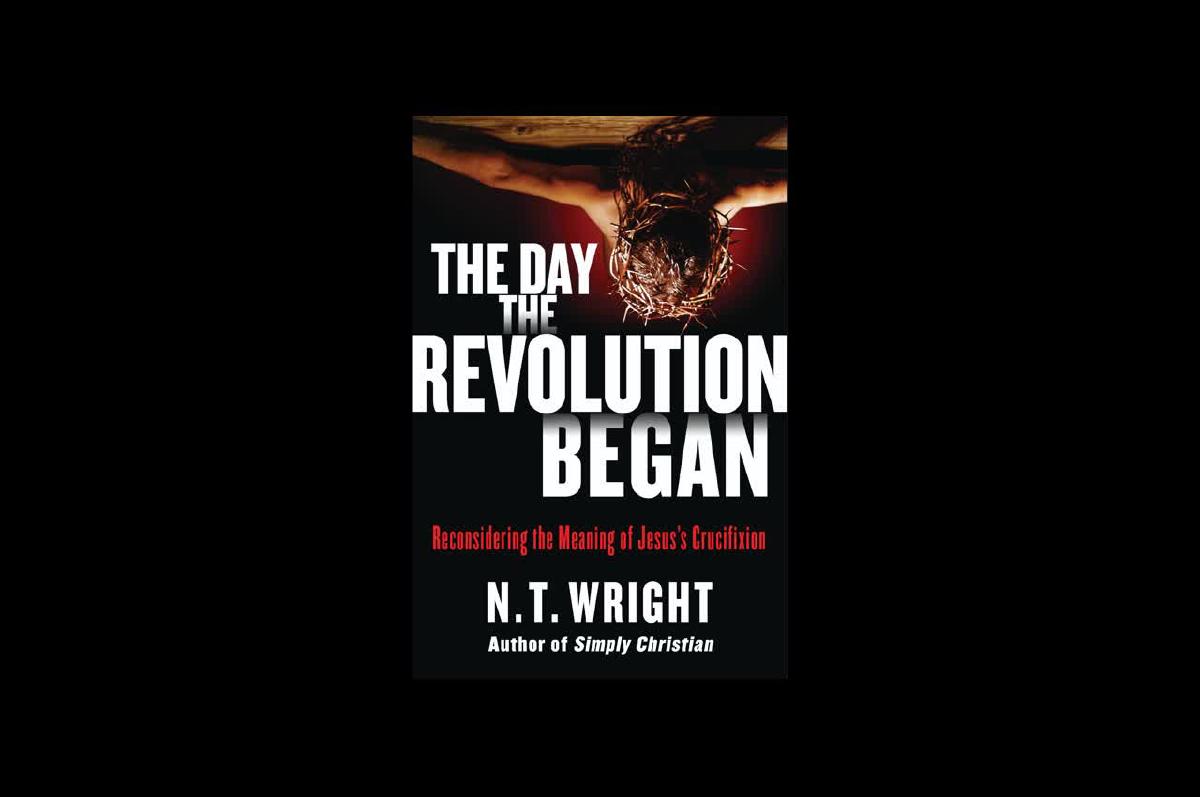

This is a book review, click here to find out why I write them, and here to find the list books I've reviewed already.
We have Platonized our eschatology (substituting “souls going to heaven” for the promise of new creation) and have therefore moralized our anthropology (substituting a qualifying examination of moral performance for the biblical notion of the human vocation) with the result that we have paganized our soteriology, our understanding of “salvation” (substituting the idea of “God killing Jesus to satisfy his wrath” for the genuinely biblical notions we are about to explore) (147)
Introduction#
Up until now, we’ve only gone through the “stories of Israel” as they’re handed down to us in the Old Testament and N.T. Wright sought to make sense of some key plots therein that the first century Christians most certainly used as their foundation of their Atonement theology. Christ himself, as he appeared to the two disciples on the Road to Emmaus, “began with Moses and with all the prophets, and explained to them the things about himself throughout the whole Bible” (Luke 24:26-27). There’s therefore a sense in which one can never understand Jesus’s work on the cross if one discards the Old Testament.
With all that in mind, Wright now turns to the New Testament where the story of “the revolutionary rescue” took place. He opens the section with the set of charges in the opening quote which he seeks to make plain knowing fully that people will inevitably push back. How does he go about making his case? The meaning will be unpacked in this article.
I’d note that this section is the very heart of this book. It is quite dense and it’s the longest section of the book. I decided to break it down in two, and deal first with Wright’s treatment of the Gospels and the book of Acts and then take on his treatment of Paul’s letters in the next article.
Platonized, Moralized & Paganized Distortions#
Jesus’s understanding of His own mission is one that fulfills rather than discards the whole of the Old Testament. He doesn’t, as Wright insists, tell his followers to discard the old promises about redeeming Israel for a new and “better idea” of “going to heaven when we die”, but rather, Christ explains that his suffering had to happen, as the Old Testament foretells, in order to fulfill His mission and calling (Luke 24:21-27). Was Jesus setting up a kind of “spiritualization” that “moves away from ‘worldly’ reality into a ‘heavenly’ dimension” (161) or is the church of the last three or four hundred years responsible for such a misreading?
If one, for example, takes Zechariah’s prophecy in Luke 1:68-77, was “the salvation of the people through the forgiveness of sins” supposed to mean a mechanism for going to heaven? If that is the case, in what sense would that be a fulfillment of Old Testament promises to David, Abraham and the national deliverance mentioned? What about Simeon’s greeting to Jesus in Luke 2:30-32? In what sense would the glory of Israel as a nation be revealed to the nations if only the new idea of “going to heaven” was in view?
“Forgiveness of sins” as Wright argues, is to be thought of in relation to the theme of “return from exile”, as we’ve discussed in the previous chapter. Whenever the nation of Israel rebelled in the Old Testament, it was sent into exile, and forgiveness meant that their rebellion/sin was dealt with and they’d be enabled to return from the exile. Therefore, there is a “national” and, consequently, a “cosmic” sense to forgiveness. However, Wright makes sure to point out that forgiveness of sins is to be thought of both on a “large, national scale and the small, personal level” (153).
What is the “goal” of God’s rescue operation as accomplished through Jesus, Wright asks (158)? If Paul in Romans 8 is right, then there’s a new creation to be born, and, as he alludes to the Exodus story, there’s a liberation from its slavery to corruption and sharing of the freedom that comes when God’s children are glorified (157). That goal has a “cosmic” aspect to it. If the goal is of a “disembodied heaven” then, in what way is Jesus death in “accordance with the scriptures”? Where do we see an Old Testament ultimate hope for a “disembodied heaven”? This is the Platonized eschatology problem that Wright identifies and seeks to get rid of.
This wrong goal (Platonized eschatology) creates a wrong purpose: that is, if people are to watch out so that they end up where “good” people are supposedly meant to go (heaven), then the purpose of life becomes truncated to be only about our morals – hence the “moralized anthropology” charge. Even if we say that we all failed an (arbitrary) moral test and that we have good news in the fact that the “goodness of Jesus” is reckoned to our account, then, as Wright asks, what then do we do with our initial human vocation of “royal priesthood” and “kingdom and priests” (Rev. 5:9-10)? If we end up with Jesus’s moral status anyway, what do we then live for in the meantime? Did God really call us to pass a moral test?
Wright is careful to note that the covenant of vocation certainly includes an aspect of moral behavior. The priesthood to which we’re called is one that preaches “repentance” and the forsaking of “wicked deeds”. That’s a given. However, what he argues is that we should not put this as the center of our calling. We turn from wickedness to and for something else! We do not repent for the sake of repenting, but we do so because we are called to an “active, involved role within God’s future world, anticipated by an equivalent active, involved role within God’s present creation” (159). Yes, we morally failed, but we failed as people who were first given a vocation; and the vocation we failed to fulfill cannot itself be reduced to the moral – would that even make sense?
It’s in this sense that Wright argues that if the ultimate “goal” is changed, then what we believe to be the human vocation would also change and if we’re to recover the ultimate goal, then something about our calling that was lost will also be recovered. “Adjust one, and we must adjust them all” (159).
With that in mind, Wright goes on and seeks to prove that the book of Acts shows us that there was a “covenant of vocation” intended for us initially, and that what Jesus’ death produced is a community of God’s people who worship and witness – a reality that ultimately points back to our calling of “royal priesthood”. How does it work?
Acts: The Cross-Shaped Kingdom#
If, as Jesus confirms, the hope of “restoration of the Kingdom to Israel” was not abandoned for “better ideas”, what might the fulfillment of this promise look like? According to Wright, the answer many Jews of that period would have provided would have been threefold. And it’s Wright’s opinion that the book of Acts shows how these three things in particular came into being (160).
- Israel must be set free from the domination of pagan overlords: One would imagine that the book of Acts has nothing to say about this particular point, but there shouldn’t be any doubt that Luke, as Wright says, saw this new community of believers as the “liberated, redeemed people, those in and for whom the long-awaited promise of rescue from pagan overlords had been fulfilled” (165). This is closely related to the next point in that the ultimate weapon of every tyrant and the ultimate exile was dealt with in Jesus himself, and therefore, these new believers were the most free people.
- Israel’s God, through the agency of the Messiah, would become the ruler of the whole world: God’s word grew and multiplied, as Luke tells us numerous times, and there’s nothing that the “kingdoms of the world” could do to change that; the persecution of the church only accelerated it – death had no power over it. Whether Herod Agrippa I, or Cesar himself, God’s kingdom was already inaugurated and therefore was unstoppable. Wright sees the job of the witness to be of announcing a new state of affairs; and we see through Acts that announcement going farther and farther from Jerusalem where it began to, as it were, the ends of the world. Those who witnessed, even though announcing “the forgiveness of sins” (as defined previously), were not spared from beatings, imprisonment or stoning; as Jesus warns, the tools of the powers of the world had to be shown incapable and ineffective against God’s kingdom.
- God’s own Presence would come to dwell with his people enabling them to worship him fully and truly: Wright sees Acts describing a “new-Temple” reality of the coming together of heaven and earth (161). We now have a part of “earth” –the human body of Jesus– now fully and thoroughly at home in “heaven” and again when the Spirit descends on the disciples. The purpose of the temple in Jerusalem is now done away with, replaced by “Jesus himself and his Spirit-filled people”. The life of worship in Israel takes a new turn in Acts and suddenly focuses on the new pattern of life of this new community centering upon “the teaching of the apostles and the common life, the breaking of bread and the prayers” (Acts 2:42). There’s a new configuration at work and God’s powerful presence, through his Spirit, is indeed with his people. Wright notes that it’s not incidental that many controversies in the book focus on temples: Stephen, Paul in Acts 14, temples in Athens and Ephesus in Acts 17-19, the Jerusalem temple itself in Acts 21:28-29; 24:6; 25:8.
Jesus’s Special Passover#
There are so many books on the “Atonement” published to date, but “none”, as far as Wright recalls, “starts with Jesus himself” (170). Many would jump right into Paul’s letters and only refer back to the Gospels as the “backstory”, but most of them will not start with Jesus himself in their effort to trace the meaning of His own death and they do not “engage in deep or detail reflection as to how the actual story told by the four evangelists in their different ways might contribute to an understanding of the theological meaning of Jesus’s crucifixion” (171). Isn’t he right about this?
How then should we go about it? Well, the Gospels tell us plainly that on the day Jesus was crucified, no one expected it; there was no immediate exclamation that Jesus died for our sins “in accordance with the scriptures”. The meaning of the crucifixion that day carried the “depressingly normal” meaning that “Roman justice was once again stamping out any sign of dissent” (173). However, on the third day, when Jesus came back, bodily, and had not gone to heaven disembodied, we find the “beginnings of the interpretation of the crucifixion” (176). No one comes back from the dead; and everyone around that time knew that:
If the prison door is standing open, someone must have unlocked it, perhaps overpowering the guards in the process. Something about Jesus’s death seems to have had that effect. (176)
Let us first backtrack for a little bit. In the Gospels, we find mainly Jesus announcing God’s kingdom and, as Wright suggests, it’s only fair to ask ourselves if that had anything to do with “the ancient Jewish expectations on the one hand, and his imminent death on the other” (179). Was Jesus “redrawing” the first century Jewish “kingdom” expectations around His own calling? Isn’t announcing the kingdom of God announcing that God is at last “overthrowing dark powers” that enslave his people? Isn’t it, in one way or the other, announcing God’s rescue? What can be said, as the Gospels make it plain, of Jesus’s choice of the Passover festival as the right time for him to die?
Jesus’s choice of the Passover was deliberate and not incidental as he could have chosen any other festival, most notably, the “day of the Atonement” (Leviticus 16). However, even as one reads the passion narratives, it is very clear that Jesus’s choice of the Passover is very intentional. In fact, Wright regards it as a “fixed point” that “Jesus himself understood what was about to happen to him in connection with Israel’s ancient Passover” tradition. There are many ways we can envision this. If the point of the Exodus is so that Israel might go and worship their God, then Christ’s “new Exodus” might imply “some kind of renewal or even replacement of the present Temple” (182). What of the Passover meal? Wright says:
Instead of looking back fifteen hundred years or so to the great event of the Exodus from Egypt –though that inevitably remained in the forefront of everyone’s mind on that day – he turned the meal around so that its primary significance looked forward to what was going to happen the next day. (182)
Reflecting on the Exodus from Egypt in parallel with Jesus’s crucifixion, one cannot but think that Jesus had in mind that his death was going to accomplish a similar (if not a deeper) liberation of his people from some sort of slavery and bring about the ultimate defeat of the “dark powers”. The meal at the Last Supper is especially highly evocative, that Wright submits (in my opinion, rightly) that this is the “interpretative grid that Jesus himself chose and structured” (185). John calls him “the lamb of God” – which could signify, in other words, the Passover lamb. As it should now be obvious, Wright continues to note that Jesus, even with this Passover context in mind, was going, through his death, to bring a new Exodus which in turn will bring about the real “return from exile” and the ultimate “forgiveness of sins”. Remember the words that Jesus said over the cup: “This is my blood of the covenant, which is poured out for many for the forgiveness of sins” (Matthew 26:28).
The Story of the Rescue#
What else can be said about what the four evangelists wrote? What did they have to say about the meaning of Jesus’ death? We can say with confidence that they all wrote about “God returning at last”. The nativity stories are filled with prophecies of the coming of Emmanuel, God with us. YHWH himself was “becoming flesh” and dwelling with man. The evangelists were sure they were writing the incredible story of God’s glory revealed in his “son”, dwelling once again with his people, and this time, never to leave again; to remain “to the end of the age” as Matthew writes.
However, it was not at all rosy. Even as Jesus was still a baby, we have hostile forces (Herod) rising up to kill. As Wright writes, the storm clouds gathered as early as that. As his ministry launched, there was a build up of opposition against his message especially as they witnessed his actions connected to the law, temple and the Sabbath. Christ’s message of “the kingdom of God” no doubt faced criticism and incredible resistance, some of it, spiritual in nature. Wright says:
This was how evil was gathering itself together, drawing itself up to its full height, so that Jesus’s death, when it came, would be causally and not (as it were) merely theologically linked to the tidal wave of evil. (204)
Therefore, put simply, the evangelists wrote of the story of how “evil gathered” itself and was ultimately overthrown by the Messiah; they wrote of what happened when Satan (indeed the “ruler of this world”) was dethroned and how Jesus was enthroned – He is after all, the one who now claims authority in heaven and on earth.
One thing I have to note is, before I picked this book, I had read some reviews that accused Wright of denying the doctrine of “Penal Substitutionary Atonement” (PSA). It would be really sad for Wright and indeed very concerning for his theology, because denying PSA would demand either discarding much of what the Bible says or else adopt a strange reading of scriptures. Even the story itself has Jesus dying instead of Barabbas, the righteous for the sinner; meaning that I don’t even see how one would be able to extricate the doctrine from the stories, let alone the following epistles.
Fortunately, the accusation is not true. Not only does Wright give many examples showing that the idea of “substitution” is apparent in many instances in the Gospels, whether from events that happened, parables or teachings; Wright also makes it clear, at the end of this section (210-225), that there’s clearly a punishment (Penal) that Jesus took on in our place (substitution). Christ bears the punishment that He himself marked out for the “impenitent nation”. For Wright, this is the reason why evil had to focus and draw itself up to its full height: it’s so as to inflict a deadly blow on the Son of God. That was the intention of the dark forces. What was God’s intention? He writes that “Jesus, by taking upon himself the weight of Israel’s sin and thereby the world’s sins, dies under the accumulated force of evil, so that now at last the kingdom can come in its fullness” (217).
Therefore, after reading this section, I don’t see how one can come out saying that Wright denies PSA. Perhaps the false accusation comes because Wright critiques some aspects of the traditional formulation of the doctrine, especially the way the “Wrath of God” is often mistaken as what ultimately moves God: this lies at the heart of the above charge, that we have “paganized” our soteriology in that an angry deity, just like in pagan religions, must be appeased for the world to be saved. Wright is totally opposed to any view that is even remotely similar to this. In whichever case, Wright doesn’t deny the doctrine but affirms it (I should add, in his own way). I think more should be said in this regard in the next part of the book.
Final Remarks#
In his constant opposition of the “going-to-heaven-when-we-die” type of preaching, it felt as though N.T. Wright swung the pendulum so far to the other extreme end of almost denying that there’s any truth to it. He’s careful to note that even though there are mentions of this “heaven” in the gospels, it’s to be taken as an “interim state and blissful garden of refreshment prior to that final destination” (214). Even if it were true that heaven isn’t the ultimate destination, would it not be going too far to say, as he does, that the four evangelists have virtually nothing to say about the subject? Is Wright afraid of having any hint of “platonized” eschatology in his teaching that he ended up with an over-correcting theology?
More to this point; haven’t you heard it preached that Jesus spoke about “hell” more than anyone else in the Bible? I certainly have. And, if I understand this book well, Wright is totally opposed to this. He says that in many instances when we think that Jesus is talking about hell, He is really telling his fellow Jews about the coming judgment, of “Roman troops and falling buildings within Jerusalem” (AD 70). Wright acknowledges one exception to this in Luke (when Christ warns his disciples to fear, above else, the one who can throw people into “hell”) but he’s convinced that other times, we’re only misreading, as is the case for, according to him, the Tower of Siloam warning (Luke 13:1-5), the parable of the tenants (Luke 20:9-19), the sayings of the hen and chicks (Luke 13:34) and the dry twigs (Luke 23:31). Even if this was true, we have other sayings, which in my opinion, are clearly meant to be about eternal punishment/judgment and how we should indeed fear it, especially as it is characterized as a place “where their worm does not die and fire is not quenched” (Mark 9:48). Should we think of these also in terms of the coming fall of Jerusalem? If these sayings are truly about eternal punishment, shouldn’t they be of any import in our theology?
This brings me to what some reviewers have suggested, that Wright seems to minimize the “Wrath of God”. On a positive note, I think Wright is right to keep the love of God at the forefront when talking about what moves God to come to our rescue. Even if some people say that Wright keeps trying to correct an imbalance caused by the fact that the Wrath of God is over-emphasized in our pulpits when in fact it’s not true, I have to admit that in some circles, the volume on God’s wrath is so much higher that one can scarcely hear that of God’s love. This is where I appreciate Wright’s contribution in this aspect, and, in fact, there were times when he said glorious things in this regard prompting me to exclaim that God truly “loved the world that He gave his only Son” (John 3:16). Love is what ultimately moves God to suffer and die! So I’m with Wright on this one.
However, we know that the punishment that Jesus takes upon himself, as Wright himself says, was “marked out by God himself”. Even though he (rightly) keeps us focused on why God comes to suffer for us, I empathized with Wright’s critics when they imply that he’s almost muting the fact that it’s God’s wrath that is behind the judgment that Jesus is about to take upon himself. See what I mean by swinging the pendulum so far to the other end? Couldn’t forgetting, or willingly muting God’s wrath create some distortion as well? I’m eager to know what Wright has to say about Paul’s letters in general, and hopefully in particular about this very point.
In any case, this was, overall, a wonderful section. If it produced in me a burning desire to read and re-read the Gospels over and over again and be mastered by them, isn’t that alone worth being thankful for? Either way, this was a fruitful journey and I can’t wait to walk through Paul’s letters as we trace the meaning of Jesus’s death on the cross.