
This is a book review, click here to find out why I write them, and here to find the list books I've reviewed already.
How do I “review” this book?
On the one hand, as a work of fiction, reviewing every intricate detail of the story (if that is even possible) would perhaps spoil it for anyone who would wish to pick it up; and I certainly do not want to do that. On the other hand, this is such a great book; it not only “reviewed” me, but it also has the power to “review” our current times despite being published in 1945. This is a prophetic work.
By merely trying to spell out the dystopian aspects in this work without appreciating the story itself, one risks overlooking the story altogether and only discussing the author’s worldview as well as what could be deemed as his hidden message. This is a mistake that Lewis warned against later on in his life:
…an ‘apprehension’ of a sculpture which ignored the statue’s shape in favor of the sculptor’s ‘view of life’ would be self-deception. It is by the shape that it is a statue. Only because it is a statue do we come to be mentioning the sculptor’s view of life at all. 1
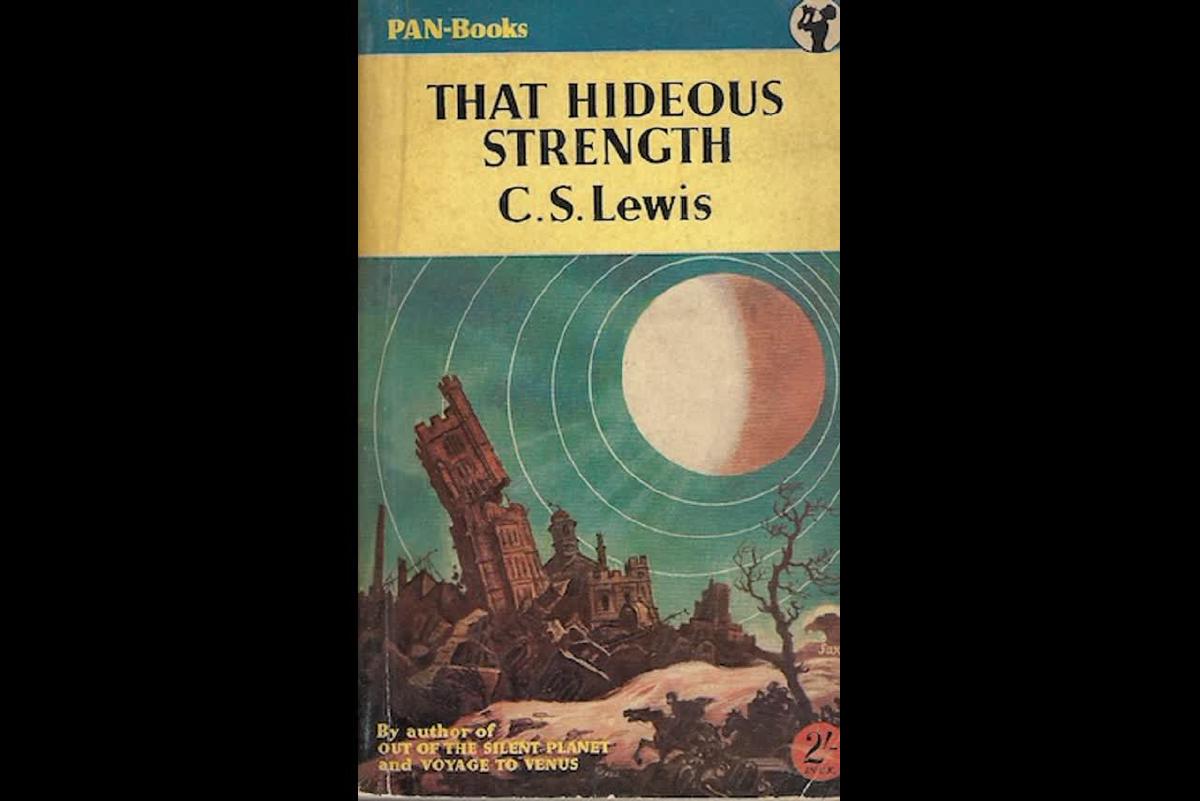
This does not mean that Lewis discouraged reviews of books (like this one), he only says that “ideally, you must receive [the story] first and then evaluate it” 2. I do feel though that I’ve not fully “received” from the book – hence my sense of inadequacy – but I plan on re-reading it, which, using Lewis’ own criteria, is a sign that That Hideous Strength (THS) is a great work of literature.
In this novel, Lewis tells the story of the inner workings within an organization he ironically names N.I.C.E (National Institute of Coordinated Experiments). It is an evil and very powerful organization whose target was to conquer “human nature” through science and technology. At first, this explicitly evil goal is sold to the public as a biological improvement through the elimination of humanity’s weaknesses; it’s only as the story unfolds that one realizes that the logical fulfillment of this goal is to get rid of human nature altogether. N.I.C.E is controlled by an evil spirit, but only a few people in the inner circle are actually aware of that.
My favorite character inside N.I.C.E is the organization’s deputy director, Mr. Wither. Once again, his name is not incidental. At the core, he’s an empty and evil person, but he knew how to put up a very “nice” facade. He is very polite and at various instances, I found myself getting annoyed by his way of talking: a bureaucratic type of speech that uses circumlocutions to disguise the fact that he’s saying nothing particularly meaningful.
At any rate, the story has at its heart a married couple: Mark and Jane Studdock. At first sight, their marriage doesn’t seem to be happy, and Lewis confirms the suspicion by skillfully uncovering its dire state throughout the novel. Their union is mercifully saved as each one of them comes “to faith” – although the “faith” aspect is a bit subtle. Mark and Jane are two very different people; they’re in fact so different it would seem that they are, psychologically and spiritually speaking, at extreme opposite ends of each other. Mark is portrayed as a person with a lust to “belong”, that is, to be part of some sort of “inner circle”. His employment at N.I.C.E makes things worse in regards to this particular trait, and, it is precisely this weakness which is exploited by the evil and demonic leadership of the organization. Jane, on the other hand, is the person who wants nothing but “freedom”. She’s a feminist who’s working on her doctoral thesis on John Donne at the university of Edgestow (where Mark teaches). She has no children with Mark yet, and it seems that this was her deliberate choice. She insists on being autonomous and it is this very obsession that pushes her to despise her husband’s inclinations. This difference exacerbates the tension and pressure in their marriage to a near breaking point.
For the bigger part of the story, this couple is apart, each on their own; Mark at N.I.C.E and Jane at “St. Anne’s”: a community of seemingly unremarkable people fighting against N.I.C.E with the help of supernatural forces of good, and under the leadership of a certain man named Ransom. This distance allows each person to deal, slowly, with the very things that drive them apart. Jane learns how to surrender, not through force but through love, and realizes that her freedom is not taken away after all but rather that freedom is marvelously (and paradoxically) found through belonging.
Mark – poor Mark – must learn the hard lesson which comes through suffering; the result of direct contact with the evil behind the circle to which he so desperately wants to belong. It is then, at his lowest point, that his eyes are opened to his own deceptions and this is exactly the window through which redemption comes. In one particular scene – and this is among my favorites –he’s ordered, as part of a brainwashing ritual in the objective room, to desecrate a sacred image. He finds in himself something greater than his usual near robotic obedience to the N.I.C.E leadership; something in him resists:
He was on the verge of obeying, and getting the whole silly business over, when the defencelessness of the figure deterred him. The feeling was a very illogical one. Not because its hands were nailed and helpless, but because…the thing, for all its realism, was inanimate and could not in any way hit back… It was a picture of what happened when the Straight met the Crooked, a picture of what the Crooked did to the Straight – what it would do to him if he remained straight. It was, in a more emphatic sense than he had yet understood, a “cross”.
There is so much that can be said about this book. I only want to mention here that the fifteenth chapter “The Descent of the Gods” is one of the most glorious pieces of literature I have (and probably will) ever read. When it comes to this chapter, words fail me. One can write substantially on various themes that are addressed in the book, especially on Lewis’ scathing critique against the “Myth of Progress” in which the uncritical blindly believes. And this a quality I’ve found particularly with Lewis; his works are the kind that provoke more thoughts. Here, I have decided to only offer a very short summary of the work in general.
This book is stupendous – a word I came to appreciate as it was used in the novel. (Also used by this reviewer). After completing it, I’ve re-read at least 6 chapters. It’s that good! I’ve resolved to read it at least once every year and write, each time, something fresh about it. Man can only plan, we’ll see how that goes.