
This is a book review, click here to find out why I write them, and here to find the list books I've reviewed already.
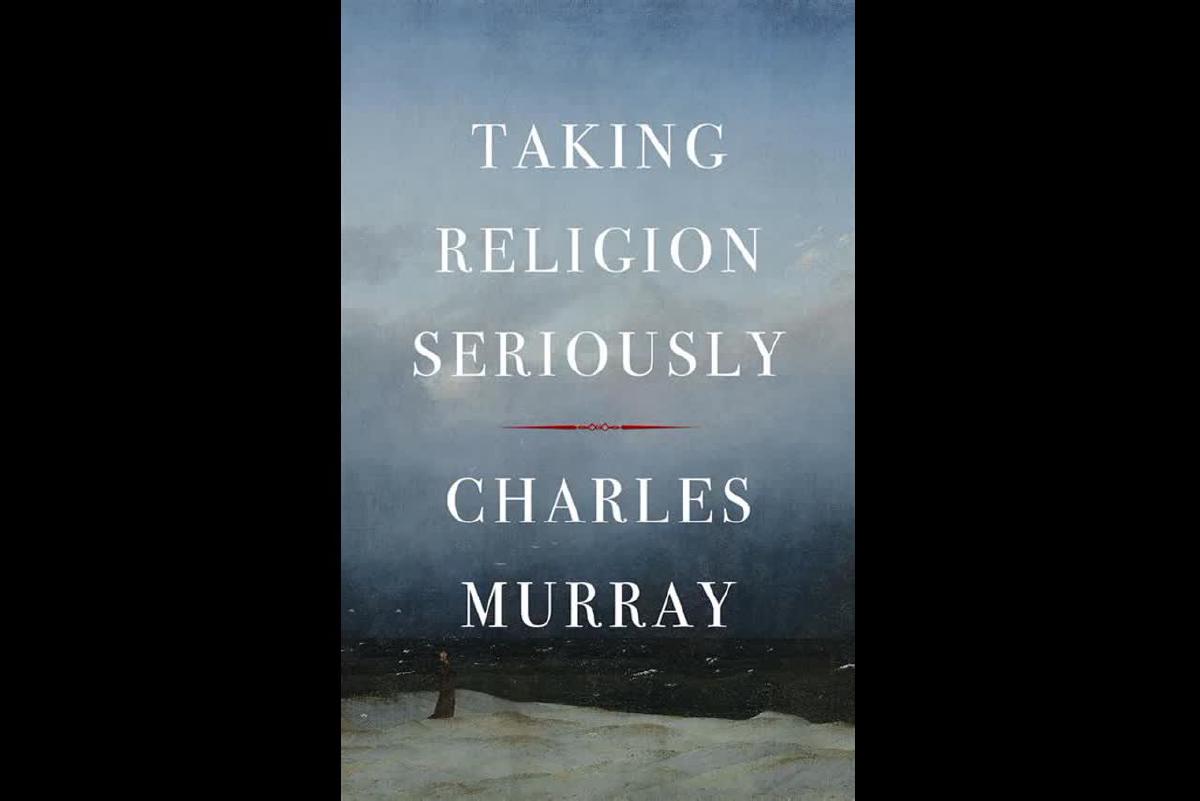
In this memoir, Charles Murray traces his journey away from agnosticism towards Christian faith. Being a spiritual and intellectual memoir, the book only gets to details of his life only when they are relevant to the story of how he comes to embrace or question a particular worldview. Of all the events in his life, his wife’s conversion to Quakerism is (probably) the catalyst that pushed him to take a closer and more critical look at religion. How can any self-respecting educated person (his wife) ever take religion seriously? He used to believe “smart people don’t believe this stuff”. So, how could she? Murray lays bare his previous prejudice against religion and later on discovers how “unreflective” his own life had been.
The journey described in the book lasted several years; which is not surprising especially if one has to change their entire outlook of the world and life in general. The story is well told, it is engaging, without veering into long and unnecessary personal details of his life. I couldn’t put it down as I was gripped by his story.
He starts off the journey when he gets a gentle nudge into looking closely into things he previously took axiomatically: why is the world behaving the way it does, ‘why is there something rather than nothing’? These, together with other similar questions, were enough to just evoke some suspicion that perhaps there’s someone or something that caused the existence of the universe.
Things get quite interesting when he starts to talk about his thoughts on the origin of the universe, especially as described in the Big Bang Theory. This was a fascinating section, as I had never read the scientific account of the origin of the universe. This addresses the question of how scientists landed on this theory and what methods are used to determine the age of the universe. In fact, Murray calls this a road-to-Damascus moment. I came to know how the initial version of the theory was proposed by an astronomer, Georges Lemaitre, who was himself an ordained Roman Catholic priest and the fact that the theory itself would have been seen as a “clumsy attempt to impose a scientific gloss on ‘God said, ‘Let there be light’ and there was light”. The whole thing is truly fascinating.
Murray is humble enough to let you know that he is not an expert in the field but this doesn’t stop him from voicing an educated observation that even science cannot discard the existence of a creator:
… I live in a universe that was intentionally designed to permit the development of life. That hypothesis…requires me to assume an initial miracle that created something rather than nothing… As far as I can tell, all the cosmologists’ explanations about the origin of the universe are implicitly saying, “I’m going to ignore an initial miracle and explain everything else.”
As he goes on, Murray brilliantly narrates how he came to let go of his orthodox materialism by showing some of the challenges to that worldview. The part about Terminal lucidity was of special interest to me as this was yet another topic I was reading about for the first time. The many near-death experiences documented (by physicians, medical staff and not loved ones who might be biased) show how it is making it increasingly hard for science to only limit the source of consciousness to the human brain: how can a person in full arrest report an out-of-body experience when the parts of the brain that are supposed to produce such are incapacitated? How can this be possible in absence of cardiac output, of respiration and of brain-stem reflexes? This, as he says, “amounts to persuasive evidence that is incompatible with a strict materialist theory of consciousness.”
Murray says this:
I lost what had been one of my sturdiest bulwarks against religious belief that involves me personally. If I am not just a brain in a body, what am I? I had to acknowledge the possibility that I have a soul.
All the above facts convince him that “God”, if one is really intellectually honest, needs to be taken seriously! This was still miles away from accepting Christianity the way his wife had. For Murray, the pivotal moment came about when a friend of his handed him a copy of Mere Christianity by C.S. Lewis. He was still reluctant to embrace religion of any kind as he still maintained that “smart people don’t believe this stuff”, yet we have in Lewis an “immensely erudite” person who believed that ‘stuff’. I was quite pleased to read of his appreciation of Lewis and how his treatment of Moral Law drove him to accept not only that “God has a relationship with humans, but that God is ultimate Goodness”. But it is Lewis’ challenge; the one where he says that no one can take Christ with ambivalence (he’s either a lunatic, a demon or the Son of God) that pushed Murray to take a serious look into Christ.
Reading this part was a true delight. Murray mounts a serious defense on the historicity of the New Testament (the text itself as well as some of the key contents of the four gospels). He rejects the revisionists that portray the stories to only be legends and offers many facts proving that the text we read in our Bibles represent true history. I appreciated his honesty when he admits that he cannot know that some of the miracles recorded really happened. However, for the great miracle, the one without which the entire New Testament would not make sense – the resurrection – Murray seems to have no choice other than accept it because, as he lays it out eloquently, it’s an event that cannot just be explained away.
As Murray points out often, this was an empirical sort of journey, and not really a spiritual one. This is to say that, what you’ll find in this book is a man tracing his thoughts and how they changed throughout the years. Even though it is a journey that tells you that ‘smart people do believe this stuff’, it doesn’t tell you how the ‘smart people’ end up kneeling down to worship God in his Son; because one thing is sure: Christianity is more than a system of thought to ascend to: There’s a LORD to obey, a God to pray to and ‘sins’ to confess – among other things. Even with the lack of the spiritual aspect of the journey, this is still a worthwhile read and a solid book for thinking and framing theism well in general and Christianity in particular.


