
This is a book review, click here to find out why I write them, and here to find the list books I've reviewed already.
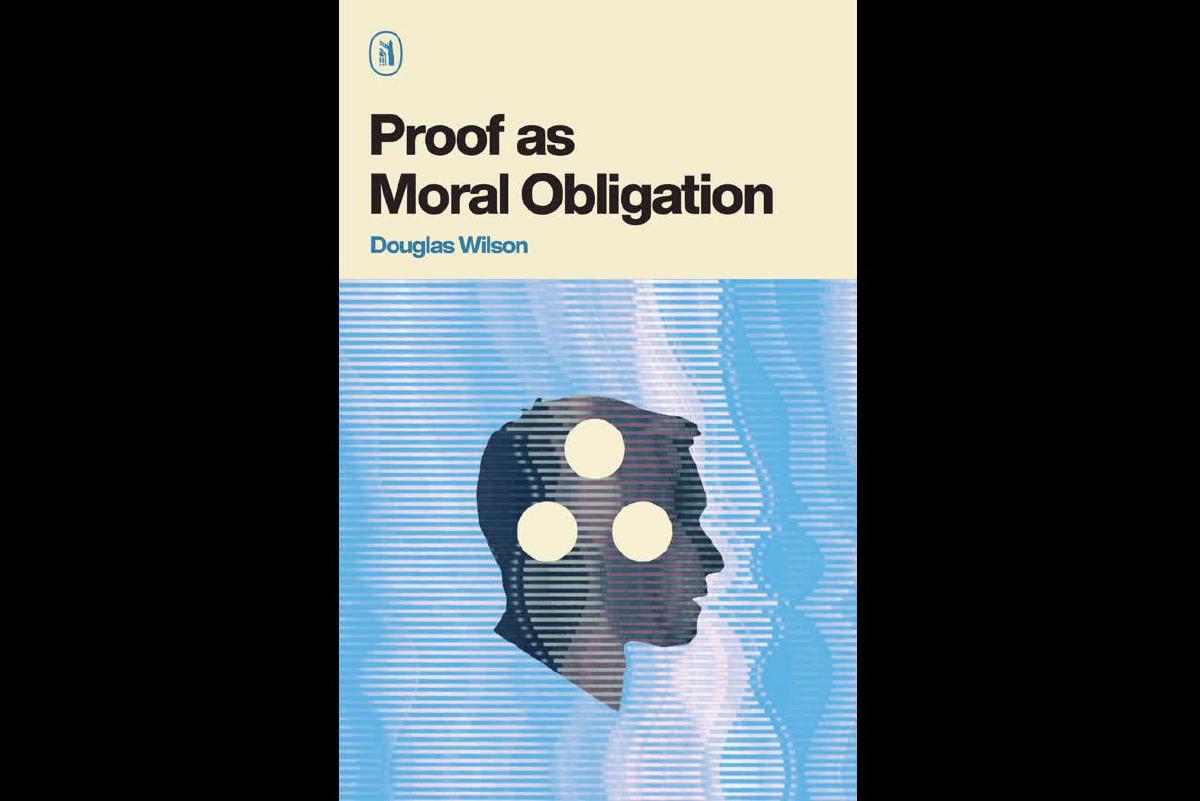
The goal of this small book is to argue that to prove something is to create a moral obligation to believe it.
When something is proven, the person to whom it is proven is under an ethical obligation to accept it.
This is the very first sentence in the book and it sets our expectations in regard to its objective and scope. Douglas Wilson’s short book, though not a philosophical treatise on what it means to prove something, is a book meant to take a closer look on the moral obligation that is created when the truth is heard. There’s something of a duty that is inherent and that one must accomplish now that they know the truth. The duty in question is not to be performed at the hearer’s leisure, that is, said duty is not to be thought of as optional but as sanctionable. There is a judgment that must take place afterwards, and there’s an account to give “to Him who is ready to judge the quick and the dead” (1 Pet 4:5). If the claims of the gospel are all preached and there’s no ethical or moral obligation to follow, why would anyone then be judged?
So the judgment will determine the threshold past which every participant was under a moral obligation to listen to what was being said.
The word threshold here is not incidental. In any public speaking setting where you have a speaker and listener, there are always people that can see the direction towards which your exposition is heading long before the speaker gets there, and others that aren’t that as quick. Moreover, the expositor’s capacity to make something plain could be questioned. The point is, for each person, there’s a threshold past which they can no longer say that they haven’t heard or understood and it’s precisely this point that the final judgment will reveal – and at this point something can be said to have been successfully proven. In other words, truth proven isn’t just one option to sit among many others without creating any obligation on the hearers. And when it comes to the gospel, the moral obligation is one upon which the hearer’s “eternal destiny is suspended”.
And it’s at this juncture that Wilson turns his focus at our postures and attitudes toward the words of truth. How do we, as apologists, take the words we are to preach? What do we count as humility and what do we count as arrogance? How do we behave in light of our partial knowledge?
On humility and arrogance, Wilson asks: “But what is better – disobedience that looks humble, or obedience that looks arrogant?” Scripture instructs that those who are to preach from it are to speak as if speaking the very “oracles of God” (1 Pet. 4:11). Wilson knows full well that such instruction sounds arrogant, and that it exhibits, some would say, epistemic hubris. However, the Lord who sends us knows how it looks and therefore how it comes across should not be our primary concern.
*Where the prophets said, “Thus saith the Lord,” we would prefer to say, “It seems to me.”
As for the partiality of our knowledge, Wilson insists that even though our knowledge is not exhaustive, it does not follow that we cannot have true knowledge. And the fact that “we cannot know the Absolute absolutely does not mean that we cannot know that the Absolute is absolute”. God knows our limits when he asks us to believe and when he sends us to proclaim the “sure” word. The section where Wilson talks of an epistemology that needs to have a certain “willingness to obey God” if it ever wants to be sensible was of much interest to me as it prompted this1 particular reflection.
And it’s in this very section where I found my favorite quote:
Lack of certainty is not measured by a calculus of admitting the possibility of error. That (ironically) is a philosopher’s game that modernity taught us. Action (not theory) is the measurement of certainty. The feelings of uncertainty that we may have in a given moment are ultimately irrelevant.
This is a short little book that will ‘certainly’ make the reader think and it is one that I wished was longer.