
This is a book review, click here to find out why I write them, and here to find the list books I've reviewed already.
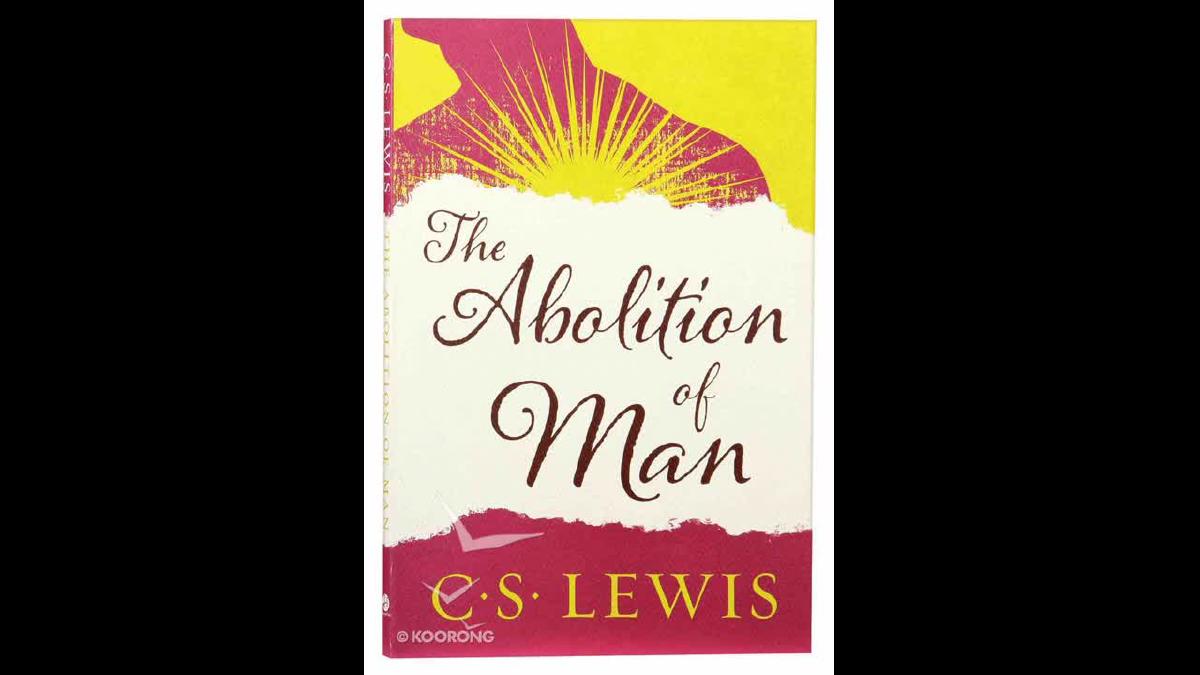
This is a very short book. It’s in fact so short that I’ve already read it twice this year. Its length was only partially why I had to re-read it; the biggest reason being the genius behind it. I had to revisit it, and I plan on doing this for the foreseeable future. I picked it up only because C.S.Lewis wrote that he was making the same argument as in his novel That Hideous Strength – another book that made its way on the list of best books I ever read.
This is a series of three lectures he gave on the subject of moral relativism and where this philosophy would lead us, if we gave it way. Lewis first tells us that the lectures developed as he reflected on what he read in The Green Book; a book he didn’t want to name. The authors of The Green Book brought up the well known Coleridge story of two tourists at the waterfall: the first one calls it ‘sublime’ and the other ‘pretty’. Coleridge endorsed the first judgment but the authors rejected it unequivocally. According to them, calling the waterfall ‘sublime’ is only saying something about oneself (and one’s feeling) and not really about the waterfall itself.
These authors (whom Lewis calls Gaius and Titius) were writing a book on education, and it is obvious that Lewis found this little paragraph appalling and as a result he couldn’t help but offer a scathing critique of their work. Lewis first points out that not only are they teaching nothing about the letters (which should be their primary concern), but they’re making it worse by trying to “cut out” the souls of their students “long before they’re old enough to choose.” Lewis also notes that his experience as a teacher is radically different:
“For every one pupil who needs to be guarded from a weak excess of sensibility there are three who need to be awakened from the slumber of cold vulgarity. The task of the modern educator is not to cut down jungles but to irrigate deserts.”
Lewis’ point is that our loves need, as St Augustine says, to be ordered and not killed. Aristotle’s aim in teaching was “to make the pupil like and dislike what he ought.” If we go down the path of Gaius and Titius, says Lewis, we’ll be in danger of raising men without chests – a fabulous expression, which is apparently borrowed from Plato! According to Lewis, “the head rules the belly through the chest”. The head here symbolizes our mind, then the belly our (animal) urges. And so, the chest is what he calls “the indispensable liaison officer between the cerebral man and visceral man.” If the chest is missing, it means there are no ’trained emotions’ – or in this case, suppressed emotions – and so the intellect “becomes powerless against the animal organism.” And getting rid of the chest doesn’t come without serious repercussions; one cannot go long without asking for the function after removing the organ one thought useless.
Lewis is certain that accepting what The Green Book teaches is accepting the destruction of society. If Gaius and Titius are teaching subjectivism, Lewis wonders in his next lecture, does it hold up under scrutiny? If everything is subjective, why did they think it good to write this book? Isn’t “good” also subjective? Where does the value of “good” and “bad” come from? Gaius and Titius might say that these values are subjective and that they come either from necessity, impulses or what benefits the most people. Lewis of course debunks each of these claims: for example why listen to your impulses? Aren’t they many? Aren’t some of them in direct conflict? Who decides which instinct is meant to be indulged and which is to be restrained? What ascribes dignity to one impulse over the other? Whatever it is, Lewis answers, it cannot be itself instinctive! Lewis then argues for a universal law (or natural law, or ‘Tao’) which is inscribed in every human being and which is the true source of our moral values; in other words, something objective and external must be the source of our morals. Lewis goes further to show how The Green Book itself relies on the Tao and that the authors’ rebellion is really a “rebellion of the branches against the tree.”
In the last lecture which bears the title of the book, Lewis talks about the aim of this moral subjectivism. If man covets the power to create his own values, he’s really aiming at conquering ’nature’ itself. Man wants supreme authority. However, Lewis reminds us that any power exercised by man is also ‘a power over man as well,’:
“There neither is nor can be any simple increase of power on Man’s side. Each new power won by man is a power over man as well. Each advance leaves him weaker as well as stronger. In every victory, besides being the general who triumphs, he is also the prisoner who follows the triumphant car.”
If man wants the power to make himself what he pleases, if indeed “human nature” is to surrender to man, then it can only mean that man wants to grant some men “the power to make other men what they please.” One can already see what nightmare that will quickly become. Humans will be designed and engineered from labs. As for what will be taught; it used to come from the natural law, but since they now “know better”, it will also be engineered by those whose authority it’ll be to produce them. History, Lewis says, is yet to show us one instance of a man who has attained power and has used it benevolently. In other words, it’ll not be a happy affair.
Finally, in one of the most quoted passages, Lewis is keen to conclude that the natural law (or Tao, or First Principles, or Traditional law) is not something that one can just “see through.” He says:
“You cannot go on ‘seeing through’ things forever. The whole point of seeing through something is to see through it. It is good that the window should be transparent, because the street or garden beyond it is opaque. How if you saw through the garden too? It is no use trying to ‘see through’ first principles.”