“But you must understand, Jack, that truth is relative…I hope you know that,” said Leo trying to persuade him.
“I disagree. It never was, and it never will be,” retorted Jack.
“Don’t you think that the statement is, by itself, illogical? And to be honest with you, this is an idea I’ve come to truly hate.”
Leo was perplexed. He wasn’t sure how to respond to a clearly emotional and negative response to something which he thought to be universally agreed upon.
I overheard this discussion as soon as I’d taken my seat at my favorite spot in this 24/7 coffee shop, only that this time I came late in the evening and there was practically no one left other than these two gentlemen who were plunged deep in discussion. I don’t know how they had come to this point in their conversation, but, since the place was so quiet, I could hear them clearly from where I was and, thanks to the overhead light at their table, I could also see their faces. I followed their conversation from a distance.
“How do you mean Jack? There are many other sayings that essentially convey the same thought – ‘beauty is in the eye of the beholder’ particularly comes to mind. I could even add the one that says that ‘one man’s meat is another man’s poison’. All these are, arguably, saying the same thing; that truth can be perceived differently depending on the angle from which you’re observing. You don’t mean to say we’re all irrational for adopting these sayings, do you?” Leo finally answered, after an awkward pause.
“Sure, I’d grant it that a pair of shoes that looks good to me might look ugly to you, but that’s not to say that there aren’t things that are universally beautiful or ugly. Walking in a room where a mad man just stabbed and killed people is a universally ugly sight. No one in their right mind would call that beautiful. There’s no angle from which to look at this horror scene and find beauty!”
“Well, if you put it that way…”
“There’s certainly something true about the saying,” interrupted Jack, “but you cannot elevate it into an absolute; that’s way out of proportion!”
“I agree, but you have to admit that…” said Leo, before being interrupted again.
“That’s, by the way, the reason I hate this idea. The fact that it’s framed into something obvious and self-evident thus tricking people into applying it to all sorts of things. Before you know it, a person who would be universally known to be male from ages past gets labeled as a woman depending on how one feels. And also before you know it, texts no longer have meaning, since meaning is created by whoever is interpreting disregarding the context.”
“Jack, I think you’re taking it a bit too far,” said Leo, this time trying to calm him before he got carried away.
“No, I’m not,” answered Jack, making sure Leo noticed his voice was calm all along, before continuing.
“I’m only taking the idea to its logical but unfortunate conclusion. Sadly, because of such thinking, reality is no longer something to which people must conform, but it’s become something that can potentially be shaped anyway anyone feels. Reality is much bigger than that, and it does not care about our feelings. The truth is, if you put your hand into the fire long enough, you’ll be burned severely, regardless of your philosophical beliefs about what the fire does to your hand.”
“I see how you’re connecting this to current debates in our culture, but let’s not debate that right now. I’ve got to ask though; do you honestly believe the idea of subjective truth brought all this up?”
Jack asked, “What else could be the origin? This view locates the truth inside an individual rather than it being objectively and distinctly external. Isn’t it what brought such (nonsensical) sayings like my truth and your truth?”
Jack then paused for a minute and lowered his voice as if to say something very important: “Truth is truth whether I’m around or not, whether I assent to it or not. Truth is like the sun, it will rise whether any of us ever wake up tomorrow. It’s bigger than anyone. It doesn’t depend on anyone’s perspective; the sun is objectively out there. Likewise, truth can never be ‘mine’ to possess especially if ‘yours’ could be different. It wouldn’t be truth to begin with.”
Leo then thought he should say what he wanted to say earlier before he got interrupted.
“Okay, but you’ve got to admit that people can view things differently based on their backgrounds and contexts. That stands to reason, doesn’t it?”
“Yes, indeed, people have all sorts of opinions about things. However, those opinions do not thereby become truth because of how they were acquired. The fact that my entire village believes in something doesn’t automatically make it ’truth’! Truth is not determined by who holds it or how many hold it.”
“Coming back to what brought this all up,” Leo quickly said before they got derailed, “could you then tell me what makes my belief true? Some things cannot be verified scientifically! What makes your religion more valid than other religions? And you know how religions make wild claims, don’t you? They claim to hear from God and know what the future holds. How can any of that be verified? This is why I think it wise to just embrace, in this instance, the fact that truth is relative. Have you ever heard of the parable of the blind men? They were asked to describe an elephant, and since the blind men had never seen one, they came up with different descriptions based on which part of the elephant they briefly touched. Likewise, our religions come to different conclusions and we raise our children to believe what was handed down to us. It’s all relative, as different cultures have their own beliefs. That can’t be illogical now can it?”
Ah, it all started to make sense and I understood at once what brought about this interesting discussion.
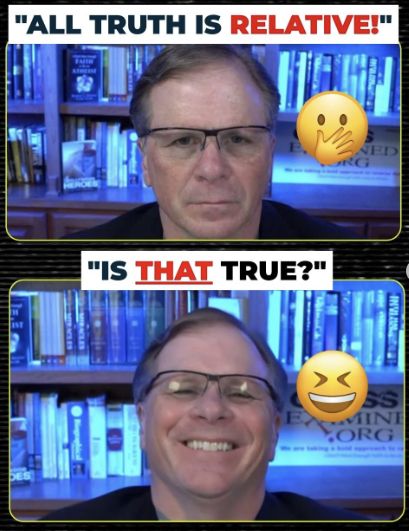
Based on the expression on Jack’s face, it seemed that he hadn’t been stumped by Leo’s question. He did not lose a second to respond: “First, even in matters of religion, the saying about subjective truth doesn’t apply. Either we, Christians, are right (in which case ours is the truth) or we’re wrong (in which case our beliefs cannot and should not be called truth). The contradicting statements from two different religions cannot be simultaneously called ’truth’. If Christians believe Jesus to be the only and rightful Lord of the universe, they believe it the same way we believe in the fact that you’ll get burned if you put your hand in the fire. The time will come when, so we believe, this will be tested and shown to all to be reality. There’s nothing subjective about it. And, as any truth, it doesn’t depend on my upbringing or my culture, the same way 1+1=2 is truth regardless the age at which I came to believe it.”
Leo didn’t want to let Jack off the hook so easily, so he asked again: “But what about the parable of the blind men and the elephant? Surely it says something profound about our difference in perspective, doesn’t it?”
Jack appeared to be pleased at Leo’s insistence: “We have to be just as careful about parables as we would for any other cliché. These maxims shouldn’t be made to bear the weight they’re made to bear. This parable perfectly brings back what I said earlier about the occasional illogical aspect of such sayings. When someone says ’truth is relative’ isn’t that also supposed to be relative? Or do they assume that theirs is the only statement which is to be taken as objective? Same with the parable; one wonders who’s telling it, and why does he assume that he’s not a blind man as well? Why does he claim the high status of being able to see and why does he consign everyone else to blindness? If this parable is applied to religion, on what ground does he claim all religions are blind? Don’t you think he’s kind of arrogant? I know I’m analyzing the parable beyond what it calls for, but such is required when the parable is misused this way.”
He added: “Also, why does this person get to be the only one who sees the real shape of God? What grants him such status? What does he have that we do not?”
Leo did not expect this answer. In a serious tone he then said: “Jack, you’re my friend, but I wouldn’t want to leave without pointing how arrogant you also sound. This is precisely what religion gets wrong and it’s this very attitude by religious people that I can’t stomach. You are too bold in your certainty and claim to know it all. How hard is it to see and acknowledge that it’d be better to just embrace humility and acknowledge the validity of other people’s opinions?”
“Don’t you also see, " Jack answered as humbly as he could, “that you’re assuming exactly the very position of the one telling the parable of the blind men? It seems you’re pleased to tolerate a plurality of perspectives, except mine. Why is that? Why doesn’t your own philosophy help you joyfully embrace my perspective? (Not that I think it’s correct, but) Don’t you think it has something to do with its unreliability and its shakiness in terms of foundations upon which to build one’s life? As for the sin of certainty, you sure also strike me as a person who’s pretty certain of what you assert. How different are we? And as for arrogance, since all is relative, perhaps in my view I’m really not arrogant and I don’t think you want to say I’m seeing it all wrong, as that would be totally against the very thing you’re supposedly standing for.”
Leo realized there was no convincing him, at least not that late anyway. He then politely smiled and asked that they should get ready to leave. Jack agreed and convinced him that they should continue this discussion and I heard them planning to meet another day for just that purpose.